Or why perceptions should come first
This article was first posted on my Substack account – You can find it here
Almost everywhere I look, it feels to me like we are constantly trying to get eggs by way of the brownie. This is major in osteopathy and craniosacral therapy, but not only.
Today, we will focus on meditation and yoga as most of my readers at the moment are osteopaths or manual therapists and it is good to take them away from their natural world so they can reason instead of focusing on words by which their minds have been trapped for years. It’s the same as asking a patient to walk backward on a treadmill. Most people believe the goal is to build more muscles, but it’s only to place them in a situation where they have to feel instead of constantly using the same pattern of movement.
Meditation – definition from the web
• Wikipedia:
Meditation is a practice in which an individual uses a technique to train attention and awareness and detach from reflexive, “discursive thinking,”achieving a mentally clear and emotionally calm and stable state,while not judging the meditation process itself.
• Cambridge:
The act of giving your attention to only one thing, either as a religious activity or as a way of becoming calm and relaxed.
I would disagree with those definitions, but that’s not our topic today. The point is that we could write a thesis about meditation, read books about it, and attend international conferences, but that wouldn’t lead us to understand what meditation is.
Now, some of you might say that what matters is practicing meditation. And you are right. But most people would also totally miss the point of what that means.
Why? Because they would start from the definition above, and the exercises given by people who wrote those definitions.
They would try to get the coffee by way of the tiramisu, the tiramisu being either the definition or a text written by someone about what is supposed to be felt during a meditation. Believe me, I love tiramisu, but I also meet many people who are very frustrated with their meditation practice and I believe it has nothing to do with meditation itself, but with the fact that they are starting from what they are told meditation is or the results they should achieve through it. Hence they are constantly missing the meditation itself.
Maybe one could sit down and forget about meditation. Forget even about the word. Forget about this stupid idea that it is supposed to calm your thoughts, or worse, regulate your nervous system. Start with that. Just sit down. Tell me what is happening when you kind of change your point of view. You were on a train, hence moving with it. Now you are sitting beside the railway and you can see the train moving. I offer you describe the movement of the train from a felt-sense perspective. And maybe experience the fact that the observer is not moving. Meditation is just “not taking the train”. The effects of it are almost accidents. They happen, while you are not taking the train, but focusing on them is taking the train.
By doing so, you won’t reach a meditation state. You are meditating, but you can only say so afterward. You can’t understand the process that life is by stopping it, you have to experience it.
Every time you sit down, you are the first person to ever sit down and wonder what happens when you stop thinking your life. At first, it will feel like you are joining the flow of life every time you sit down. Maybe one day you’ll start to feel you are constantly in the flow of life as a natural state but that you sometimes try to swim against the current. But you’ll discover it all by yourself if you decide to just sit down in silence once in a while. And if you do so, you’ll understand even though I am not J. Krishnamurti, we’ve both experienced the same thing and we are pointing at it with our own words:
“Meditation is one of the most extraordinary things, and if you do not know what it is you are like a blind person in a world of bright color, shadows, and moving light.
It is not an intellectual affair, when the heart enters into the mind, the mind has quite a different quality: it is then really limitless, not only in its capacity to think, to act efficiently, but also in its sense of living in a vast space where you are part of everything.
Meditation is the movement of love…
This meditation cannot be learned from another. You must begin without knowing anything about it, and move from innocence to innocence.
The soil in which the meditative mind can begin is the soil of everyday life, the strife, the pain, and the fleeting joy. It must begin there, and bring order, and from there move endlessly… You must take a plunge into the water, not knowing how to swim. And the beauty of meditation is that you never know where you are, where you are going, what the end is.”
J. Krishnamurti, Excerpt from Meditations, 1969
Sit down, listen, and tell me what meditation is. This is the practice.
Yoga and asanas
Let’s talk about an asana called Balasana, or child pose. It is very frequent to hear teachers telling you that Balasana has several benefits. This is for example what I found online:
- Lengthens the spine.
- Opens the pelvic floor.
- Lowers blood pressure.
- Alleviates low back pain.
- Relaxes the brain and nervous system.
- Aids in fighting insomnia and depression.
- Have therapeutic effects on the digestive system.
- Alleviates stress from the spine, glutes, and shoulders.
- Enhances blood circulation and re-energizes the body with Prana (energy).
- Stimulates abdominal organs, like – kidneys, intestines, liver, and pancreas.
If you are reading that and you have back pain, it could feel tempting to try this pose. And you are not wrong, as it could be beneficial. But that’s not what I am offering you to practice. The path I invite you on is to practice Balasana without even knowing its name and to observe what happens so you can create your own list. And every time you get into the pose, I offer you to start over and see what is happening. Constantly listening. An eternal learner, quoting only experience.
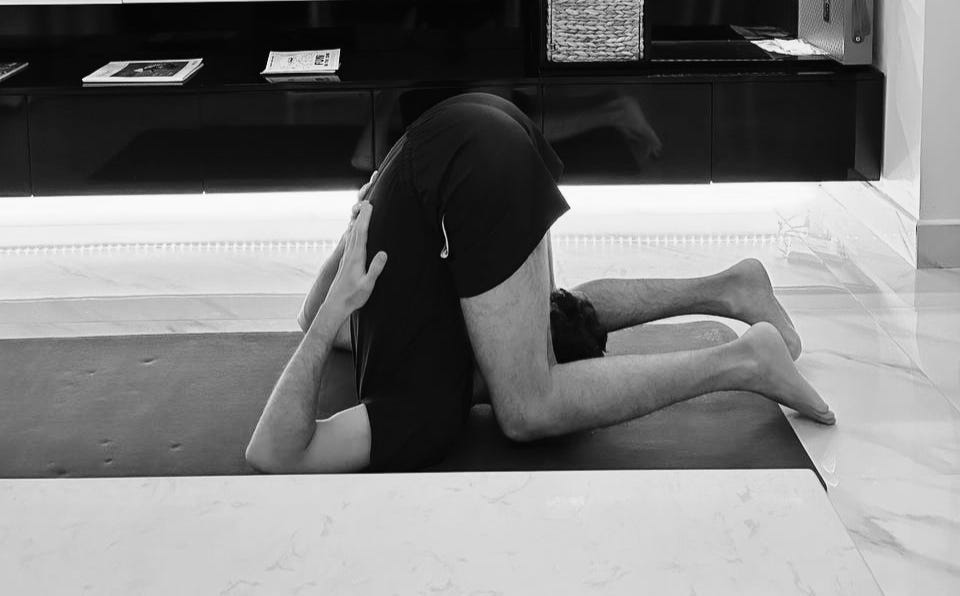
I don’t have a picture of me practicing Balasana. But the idea is the same as meditation. Get into Balasana and tell me what Balasana is, what it does to you.
Anatomy and patients
Now, back to something more familiar to osteopaths. Many osteopaths believe that if they can name ligaments, and give their direction, they know anatomy. But couldn’t we apply the same thing as we did for asanas to ligaments?
Instead of focusing on names, couldn’t we know anatomy by experiencing it? From books, dissections, and patients…can’t we develop a felt sense of what a femur is? That could lead us to know not only when a femur is “normal” and when it’s “abnormal”.
Could we even practice that with our patients? So when a patient would talk to us, we would have a perception of what is happening? Not an intuition, or a tension felt by running an osteopathic test. But we would perceive something, a pure perception at first, and from there we would be able to tell that it is what we refer to as the femur and that it is “dis-eased”. It wouldn’t be a thought or a question that we would ask angels or the universe. But we would know it is right, just as much as we feel how hard a piece of furniture feels when you knock it with your pinky toe.
I’d say we can. Not because I believe so, but because I do it on an everyday basis. For this to be true though, perception has to come first, and not second.
It is a lifelong journey.
And I wish you Godspeed.
That’s all for today. Should you like to receive my newest articles via email, you can subscribe here.
Love,
Jules
Leave a Reply